Published on October 1, 2026
Local Sourcing in Restaurants: “We Can Make It Happen”
Thirty years ago, putting a prestigious ingredient on the menu often meant importing it. Today, a humble carrot grown just down the road can take center stage on the plate.
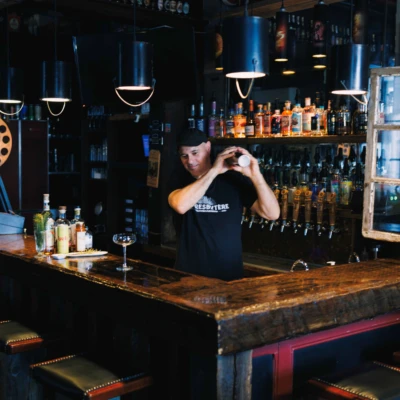
“Back then, the more exotic it was, the cooler it was,” says Isabelle Dupuis, chef-owner of Microbrasserie Le Presbytère and winner of the Prix restaurateur Aliments du Québec au menu 2025.
Today, she sees her customers taking a greater interest in lesser-known ingredients from Québec, such as sweet clover (an aromatic plant with notes of vanilla), sea buckthorn (a small, tart orange berry) and redfish (a fish found in the St. Lawrence River), as well as products foraged right in her region. Just a few decades ago, these ingredients were far less accessible and certainly much less likely to take center stage on a menu.
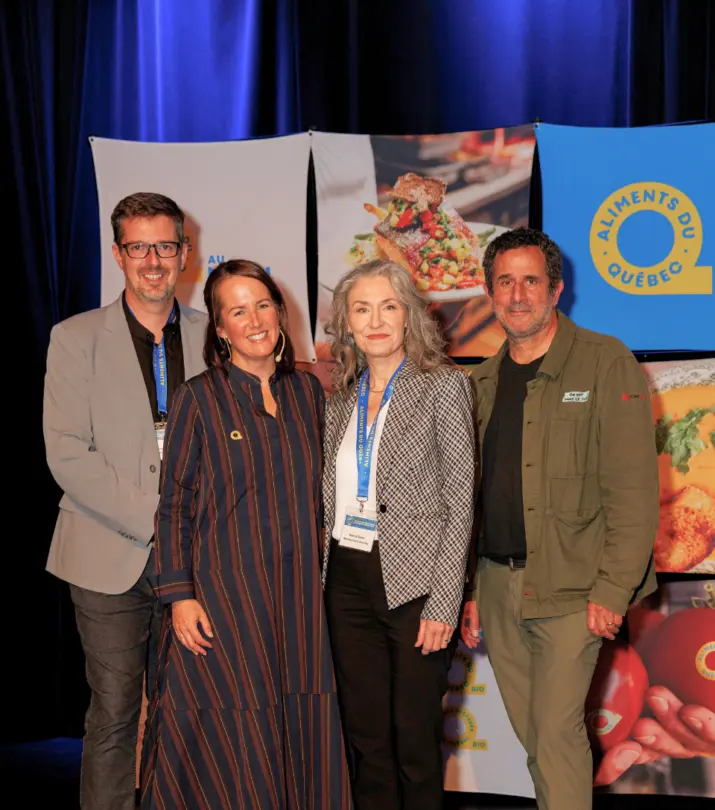
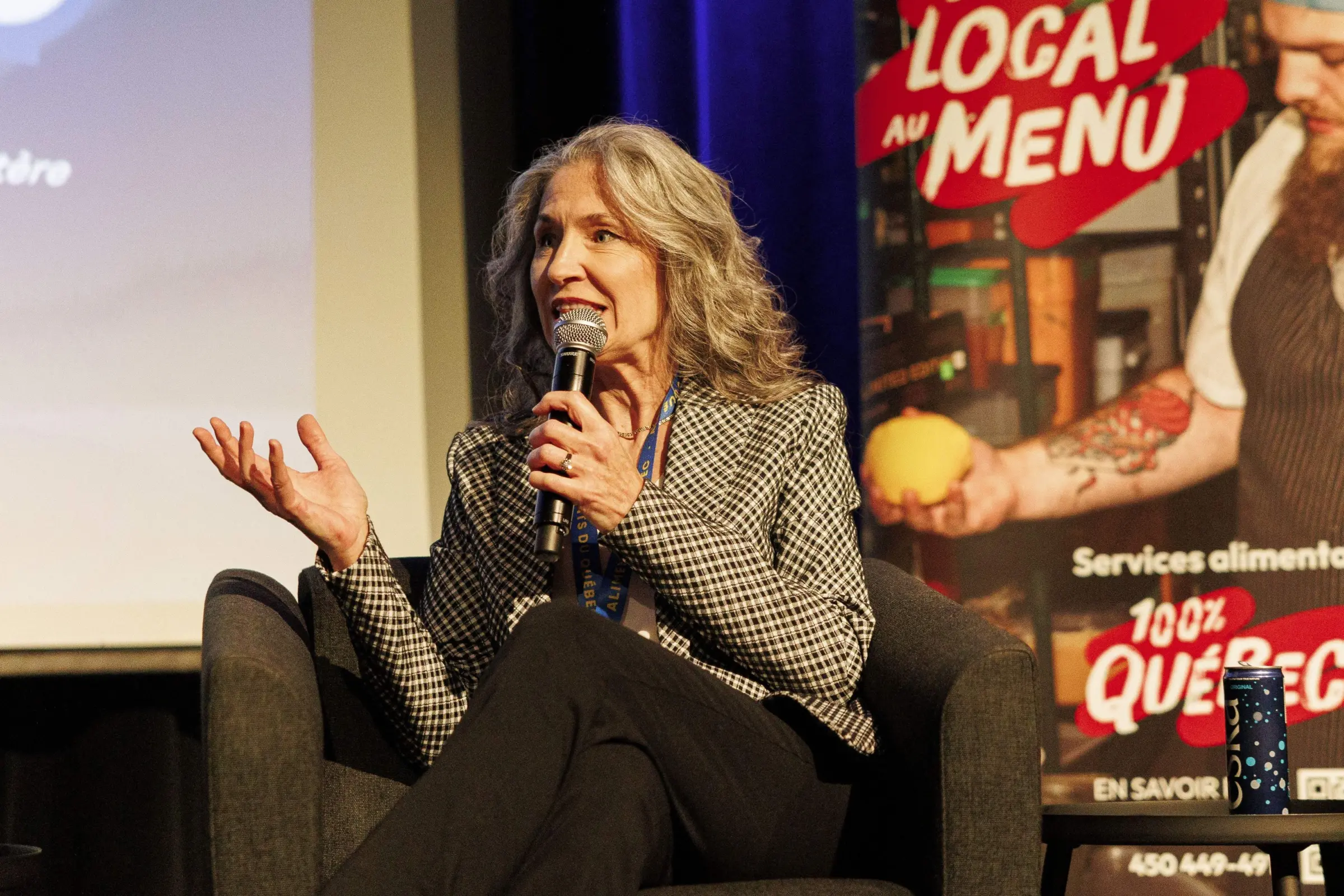
This shift in perspective was at the heart of a discussion on the evolution of local sourcing in the restaurant industry, hosted by Geneviève O’Gleman and bringing together Isabelle Dupuis, Norbert Gagnon, President and CEO of Groupe Normandin, and Pascal Hourriez, co-founder of On est dans le jus.
Three very different perspectives on the restaurant industry, but one shared conclusion: over the past 30 years, Québec food products have gained significant ground. And there is still plenty of room to go further.

“Our customers are asking for it”
What has changed? The products, of course. But also the people eating them.
“Consumers have become more knowledgeable,” says Norbert Gagnon. At Normandin, this shift is reflected directly in purchasing: approximately 80% of the products they buy come from Québec, while another 10% come from elsewhere in Canada.
And according to Gagnon, the demand also comes from customers themselves: “Our customers are asking for it!”
For a chain of this size, however, buying local means more than simply finding great products. Recipes are standardized and need to deliver the same experience from one restaurant to the next. Suppliers therefore need to be able to meet the required standards for quality, consistency and volume.
That does not mean there is no room to build relationships with Québec businesses. About a decade ago, for example, Normandin was looking to improve its coffee. The team discovered Brûlerie FARO, and the partnership led to the development of a custom blend that met Normandin’s needs: higher-quality coffee, roasted locally and available in the volumes required by the chain.
The same goes for mayonnaise. Québec company Mayo Mag developed a recipe specifically for Normandin.

Small businesses that can grow alongside their customers
Sometimes, a partnership begins long before a supplier is ready to meet demand on a large scale.
Norbert Gagnon recalls Normandin’s early days working with Firebarns, whose sauce was used on one of the chain’s pizzas. At the time, the company was still in the early stages of its growth. The first deliveries were rather makeshift: products were unloaded from a personal vehicle at Normandin’s large loading dock.
“That sounds almost like bootlegging!” Geneviève O’Gleman joked.
But behind the anecdote lies something much more interesting: when a restaurant gives a product a chance, that first opportunity can help the company behind it grow.
Pascal Hourriez builds on the example. In his view, a chain like Normandin also has an important role to play in helping consumers discover local products. Someone might try a Québec food product at a mainstream restaurant, get to know it, and then become more curious about what is being made here. The restaurant becomes much more than a place to eat. It becomes a link between the people who produce food and the people who eat it.

How do you get Québec products on the menu?
First, you have to find them. On that front, Isabelle Dupuis’ reality is very different from that of a large chain. She works directly with producers and foragers in her region.
“It takes energy to track down those local gems,” she says. But once a relationship is established, it goes well beyond a simple transaction. With one of her vegetable growers, for example, Isabelle speaks of “mutual respect”: she understands the challenges the grower may face, while the producer takes an interest in how her products are prepared and the constraints of working in a restaurant.
Pascal Hourriez agrees. According to him, many chefs still use their own time to search for products, meet the people who make them and learn where their ingredients come from. But he also sees a shift in the industry: chefs are increasingly sharing resources and recommendations. Competition does not necessarily stand in the way of collaboration. A great discovery can make its way from one kitchen to another.
And the products themselves have become easier to find. “Companies are closer to restaurateurs,” says Norbert Gagnon. Isabelle Dupuis also points out that distributors now make it easier to identify Québec products, including by providing clearer information about their origin in their catalogues and offering selections identified with the “Aliments du Québec” designation.
In other words, Québec food products are much easier to find than they used to be.
Making it easier for products to reach restaurants
Despite this progress, some very practical challenges remain. For Isabelle Dupuis, delivery and logistics are still particularly complex in the regions. “Some fish travel along Highway 40 all the way to Montréal, only to make their way back to the region!” she says.
For Pascal Hourriez, initiatives that bring producers and restaurateurs together can help bridge the gap, but they need support to grow beyond major urban centres. Isabelle Dupuis also points to another challenge: administrative burdens.
The takeaway is clear: if we want to make even more room for Québec products, we also need to make it easier for them to reach restaurants.

“One item at a time”
Faced with all these challenges, where do you start?
Norbert Gagnon’s answer is simple: “We take small steps, one item at a time.”
A coffee. A sauce. Strawberries from Île d’Orléans. Gaspé lobster. Then another product. This pragmatic approach also helps challenge another common assumption: that local products cost more.
“It’s simply not true that buying food from elsewhere is cheaper!” he says.
Price varies according to several factors, including the ingredient, the season, the volume and the logistics. But his experience shows that importing is not automatically more economical. And every time a restaurateur chooses a Québec supplier, that choice has an impact throughout the value chain.

In 10 years, not having to ask the question
What could Québec’s restaurant industry look like ten years from now?
For Isabelle Dupuis, true success would almost mean no longer having to talk so much about local sourcing. She wants “local to be the norm, not even something we have to question.” It should naturally be part of how restaurateurs build their menus.
Pascal Hourriez expresses an equally simple wish: “That it be easier for everyone.” But he adds an important nuance: “Behind the food are people who work incredibly hard. Growing local sourcing also means finding a balance that allows producers, processors and restaurateurs to make a good living from their work without burning themselves out.”
Norbert Gagnon, for his part, dreams of seeing even more fruits and vegetables grown in Québec.
“We’re going to have to invest!” Pascal Hourriez responds.
“I’m on team dreamer,” Geneviève O’Gleman concludes with a smile.
And perhaps that is the best summary of the discussion.
Over the past 30 years, Québec’s restaurant industry has changed. Ingredients that were once relegated to the sidelines have become the stars of our plates. Producers and restaurateurs have developed new ways of working together. Small businesses have grown. Large chains have shown that local sourcing can work at scale. And consumers themselves are asking for more Québec products.
The challenge in the years ahead will be to make sure that what still relies too often on the energy, resourcefulness and commitment of a few passionate people becomes simpler, more accessible and more natural for everyone.
Until the day when choosing a Québec product is no longer the exception, or even something worth pointing out. It is simply the norm.

© Photos credit : Émilie B. Meunier